- ámbito
- Portada en Ingles
Lousteau quits ahead of dismissal, Gov't rejected his plan against inflation
Although rumours of change abounded, everybody imagined that Martin Lousteau was going to be fired from economy ministry. Yet, it was the other way round. On Thursday night, he took the decision. Cabinet chief Alberto Fernandez accepted his resignation. Continuity of the young minister might have become unsustainable during the last weeks after having to endure all kind of objections from the other presidential bunker. On the other hand, his leave might also decompress farm clash: what's lost on one side, it can be gained on the other (in the end, Lousteau area implemented export tariffs that got farmers crazy and triggered the greatest setback in government since the Kirchner couple starting managing Argentina 5 years ago). All the same, Lousteau accumulated displeasures on the one side (constant and persecutory slip of internal trade secretary Guillermo Moreno, fuelled by Nestor Kirchner) and dissatisfactions on the other: he received no answers to his observations about the nonexistent policy against inflation. This newspaper, some months ago, disclosed some of his papers questioning not only figures of the statistics institute INDEC, but also participation of the controversial Moreno in areas not belonging to him. "Easy, easy, we'll see. We're working, we go little by little. We don't want economy to cool down, don't worry." These were the constant excuses to Lousteau's appeals with respect to inflation (not to mention other political complaints), which, according to the resigning minister, may spiral across the year. Meanwhile, according to reports, ex president Nestor Kirchner was allegedly asking ideas to different economists. True or not, such rumours did not go unnoticed to Lousteau, who started to prepare for his leave. Reasoning: if I go, I go whenever I want, not when they want. Cautious, however, in the meantime, he had brought to Cristina different initiatives of macroeconomics that could be extracted from a basic handbook of any college. Namely, a) rising services tariffs, a change which, in subsidies, represents 0.4 per cent of GDP and which, to the present, is only enjoyed by the richest (and spent, of course, in other areas). Such percentage, nearly ARG$4 billions, modified consumption excess and constituted a saving for the State for saving in subsidies; b) freezing Guillermo Moreno's activity to supermarket sector, avoiding its arbitrary and unexpected intervention in other private and public areas; c) although it had no relation with his complaints against mounting inflation, Lousteau might have refused to sign take over bid of the oil firm YPF, which requires official approval. He did not do the same with another questioned plan: the bullet train; d) Lousteau also set out a passive interest rate rise, in fact, an increase of cash minimums in current accounts and a decrease in time deposits. Goal: stimulating people's saving. Also the need that Argentine Central Bank sterilized issue more seriously; e) reconsideration of INDEC's activity, turning it into a reliable institute. Although he said nothing in public, falseness of indexes offered the possibility of creating in all sectors a criterion of "subjectivity", which eventually gave a figure. And the latter, maybe, was not correct: economy adjusted itself by what was believed rather than what it is; f) another demand was maintenance of exchange rate to avoid alleged scandals and tensions. Lousteau hardly enjoyed central bank's control, which is currently practiced; g) he also asked government spending control (strange avoidance in a government loving controls), since he believed it would keep on growing throughout the year, running the risk of turning it explosive.
Despite those were the basis of his battery to justify his leave, Lousteau also disagreed about beef and wheat. All in all, the resigning minister anticipated so as not to be held responsible (like farming sector yesterday) for mounting inflation.
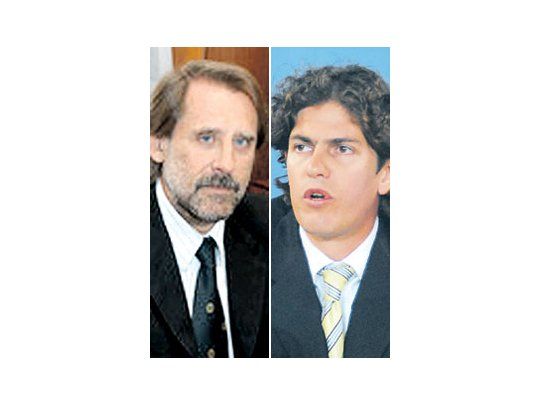
Carlos Fernandez and Martin Lousteau
SIDELINED
But he has been increasingly sidelined and hardly appeared during the talks with farmers, which have instead been led by Cabinet Chief Alberto Fernandez and controversial Domestic Commerce Secretary Guillermo Moreno, the government's price watchdog as it battles inflation.
Local media have said Lousteau clashed with the powerful Moreno over the design of a new consumer price index, a project aimed at restoring credibility to the INDEC national statistics office.
Many analysts and opposition politicians accuse the government of manipulating INDEC inflation data to under-report real inflation. Inflation was 8.5 percent in 2007, but many private analysts put the true figure at at least twice that.
As well as trying to tackle the inflation issue, Lousteau sought to advance talks on how to restructure Argentina's $6.3 billion debt with the Paris Club group of wealthy nations.
Both tasks will remain for his successor, a Peronist who served as economy chief in the large and heavily populated province of Buenos Aires.
Center-left opposition leader Elisa Carrio said the replacement showed Kirchner maintained a strong influence over his wife's government.
"It was obvious that there was only one power in Argentina and that person was Nestor Kirchner... This means Kirchner will directly intervene in the Economy Ministry; (it is) a tremendous endorsement of Moreno (and) a weakening of Cristina Fernandez," she said.
In the past, Argentina had strong economy ministers -- dubbed second presidents -- who clashed with presidents over policy. However, the post has become less independent since Roberto Lavagna resigned during Kirchner's presidency.
Lavagna was replaced by Felisa Miceli, then head of the Banco Nacion, who was forced to step down in July 2007 after a bag of cash was found in her office bathroom.
Her successor, Miguel Peirano, lasted even less time in the job, apparently because he clashed with other government figures.